
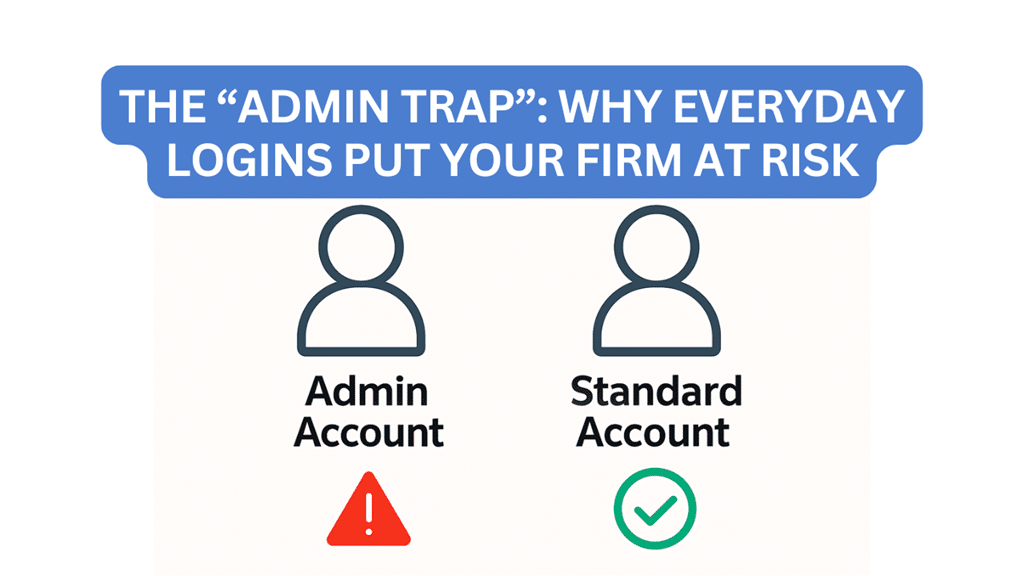
Using an administrator account in Windows 11 for everyday work is one of the easiest ways to turn a small mistake into a major security incident. When you sign in as an admin, anything you click can run with full system privileges, including malicious downloads, fake software updates, or ransomware.
A standard user account is designed with fewer permissions. That limitation is intentional — it blocks or prompts for approval before dangerous actions like installing software, disabling security tools, changing system settings, or tampering with system files. In simple terms, a non‑admin account limits the blast radius if you or an employee clicks the wrong link, opens a malicious attachment, or plugs in an infected USB device.
This is Article 1 in our Practical Security series, focused on simple, high‑impact steps business owners can take today to reduce ransomware risk, account takeover, and costly downtime — without needing to be “techy.”
Step 1: Check If a Windows 11 Account Is an Administrator
Before making changes, confirm whether your current Windows 11 account has administrator rights.
Option A (Fastest): Settings
- Click Start → Settings
- Go to Accounts → Your info
- Look under your name or email
- If you see Administrator, the account has admin rights
Option B: Control Panel (Classic View)
- Click Start and type Control Panel, then open it
- Go to User Accounts → User Accounts
- Your account type will be listed as Standard or Administrator
Option C: Computer Management (Windows 11 Pro)
- Right‑click Start → Computer Management
- Expand Local Users and Groups → Users
- Double‑click your username → select Member Of
- If Administrators is listed, it’s an admin account
Step 2: Create a Local Standard User Account (Recommended for Daily Use)
The safest setup is two separate accounts:
- One standard user account for daily work
- One administrator account used only when required
Create the Local (Non‑Admin) Account
- Click Start → Settings
- Go to Accounts → Other users
- Click Add account
- Select I don’t have this person’s sign‑in information
- Click Add a user without a Microsoft account
- Enter:
- Username (e.g., OfficeUser or Name‑Work)
- Password and security questions
- Click Next
Confirm It’s Not an Administrator
- Under Other users, select the new account
- Click Change account type
- Ensure it says Standard User
- Click OK
Step 3: Start Using the Standard Account Daily
Practical Tip for Firm Owners
FAQ: Switching to a Standard (Non‑Admin) Windows 11 Account
Will this break my software?
How will I install software or updates?
You can simply enter the admin username and password.
Do Windows Updates require admin access?
Occasional major changes may ask for admin approval.
What if an app asks for admin rights every time it opens?
It could mean the app is outdated or poorly designed.
Can I still use printers, scanners, and shared drives?
Driver installation may prompt for admin approval once.
What if I forget the admin password?
If you have IT support, make sure they maintain a recovery process.
Is this really worth the trouble?
Absolutely.
Switching to standard accounts is one of the highest‑impact, lowest‑cost security improvements any business can make. It significantly lowers your risk of:
- ransomware
- phishing damage
- accidental system changes
- unauthorized software installs
Final Takeaway
Using an admin account for daily work is a silent but serious cybersecurity risk. Creating and using a standard account dramatically reduces your exposure to malware and user mistakes — without slowing your team down.
This one simple change can protect your business from some of the most common and costly cyber incidents.
Ready to lock down your business computers the right way?
